
I became a doula out of fascination with, and desire to know, birth.
I eagerly absorbed all the content on stages of labor, comfort measures, and complications.
When I frustratedly announced, after all this learning and no application, that I was ready to attend births—my declaration was answered. I was invited to join a doula group as an apprentice.
After my first birth-witnessing experience, I was not exhilarated. I was underwhelmed. Everything I had learned about birth had gone out of the hospital window, to be replaced with beeping machines, medications, and surgical threats.
I continued my doula practice, meeting with many couples in prenatal visits to cover basic childbirth content, hospital realities, and the various choices outlined in a Birth Preferences document. I held out hope that some clients, or some hospitals, might produce different experiences.
Instead, over and over, I saw ideal clients doing their best to be great students of the hospital, and graduating with the honors of perineal tears and high-intervention (surgical, forced, rushed, “augmented,” injurious) deliveries.
“Everyone is healthy!” went the refrain of the newly traumatized family.
INTERVENTION
It’s fairly common for clients to come to us wanting to “avoid any unnecessary interventions.” Labor and delivery staff will also state that their identical goal is to avoid unnecessary interventions.

Interventions include: leaving home, changing clothes, having an IV catheter inserted, fetal heart monitoring, getting in the shower, using nitrous oxide to cope, getting hip squeezes during contractions, having the amniotic sac artificially torn, getting epidural anesthesia, getting a pitocin drip to strengthen contractions, being coached to push, having your perineum manually manipulated as the baby emerges, or having the baby extracted with a suction cup pulling on its head or through an abdominal incision.
Interventions are not bad. Getting in the shower is a miracle for a lot of laboring people. So is epidural anesthesia.
The idea that interventions are to be avoided in birth comes from a very solid foundation: birth generally goes best when it is left alone.
However, hospitals work under a set of parameters that dictate constant interventions. Fetal heart tone monitoring is one of the clearest ways to identify potential distress in the emerging baby, and hospitals are therefore expected to track it closely in order to avoid liability for any could-have-been-foreseen fetal demises.
This seems so harmless. What could be wrong with constantly monitoring the baby’s heart rate? How is that even considered interventive?
This is where the laboring person’s experience comes in.
FETAL HEART MONITOR
Fetal heart monitors are not subtle. They are bulky, temperamental, loud, uncomfortable, and require constant repositioning by nurses.
When the baby changes positions (which they do, many times, during labor), the monitor stops picking up the heartbeat, and the machine starts beeping.
Did you know that labor requires deep concentration and internal focus? Try to meditate with a machine that’s supposed to be tracking your baby’s health sounding an alarm every 2 to 20 minutes.
(Intermittent monitoring, which is not much better and rarely offered for the duration of labor, is technically better for birth outcomes, statistically speaking. Meaning that constant monitoring leads to worse outcomes. Meaning that the very thing the hospital must do to protect itself consistently makes things worse for the consumers/babies involved.)
PAIN KILLERS
I have horrifying news. Epidurals are part of standard protocol in hospitals because it makes things easier for the staff to not to have to deal with people going through actual labor.
There are other painkillers available, like fentanyl and morphine, but those are usually seen as gateways to epidurals. (The best painkillers of all, endorphins, are not discussed.)
Epidurals are everyone’s favorite drug, and yet they have the worst side effects: they interrupt the natural progression of labor, which introduces the need for—you guessed it—interventions.
When there is no pain, there is no feedback loop for the body to understand what it needs to do. Which position feels slightly better, and therefore helps the baby to find its way through the pelvis? When does the laboring person need a psychedelic dose of oxytocin, in order to do the impossible and let life emerge?
Epidurals are marketed as magic, but they remove the magic from the actual magic of birth and hand it over to the mechanisms of the hospital to intervene the baby out instead.
GYNECOLOGY
I would like to take this moment to note that the practice of gynecology is descended from white men experimenting on enslaved women, and that the preexisting, premodern practice of midwifery was intentionally wiped out in order to preserve the realm of childbirth for the power and profit of men who own the companies that do this work.
NURSES AND DOCTORS
When we have a client who is determined to have a medication-free labor, we encourage them to call ahead and request a nurse who is excited about that. We hope that there is such a person on staff that day.
Nurses are deservedly tired and would like to operate their expert skillset in peace. They can monitor you, help get you comfortable, and kindly inform you of next steps in a protocol. They can ease orders from doctors and make a case for you.
Nurses are, obviously, angels.
Nurses are also operating within a system that is famously burnout-prone and under-resourced. Think of a barista who had to get a whole degree to get their job and can’t just quit to pursue a “real” career. Nursing is a real career, with the treatment of a barista. (No offense to baristas; as a former barista I am appalled at the treatment of baristas in general.)
Parents-to-be meet with obstetricians (surgeons) several times for a few minutes each leading up to the birth. They get a sense of how “their provider” (the creepy language we use for doctors) feels about birth in general, and sometimes they get an idea of what to expect from their care team in advance of the day.
When the day comes, they will rarely see that surgeon except at the very end of the whole experience, when the doctor is needed to stand by (or, more likely, intervene heavily and unnecessarily) in case of hemorrhage risks.
Meanwhile, the nurses are the primary birth coaches. It’s a new person every 8-12 hours, plus breaks, and you can’t know if anyone will be remotely interested in your big rite of passage or not. They have seen it all, and they would like for this shift to go smoothly.
Postpartum RECOVERY
New parents are given a two-day stay in the hospital in which to solidify their helplessness and indebtedness to the hospital system. Nurses teach them to swaddle and breastfeed, or supplement with formula, and then they are sent home to start recovering from all the beeping and bright lights and monitoring.
Breastfeeding starts over again when colostrum transitions to milk, and this time there is no one to manipulate the baby for you. The people you may have bonded with during the birth and recovery process are gone forever, and the only appointments you have to look forward to in the next six weeks are pediatrician visits to anxiously measure whether or not your baby is gaining enough weight to survive.
NORMAL Birth
This is all very normal.
That is, this is what is expected in birth right now. It is not considered “normal birth.”
Normal birth is a birth that is undisturbed. There is no medication, there is no surgery, there is no pulling on the baby. Normal birth happens on its own.
This is not to say that the birthing person does not participate—but they participate on an animal level, a level of necessity and of instinct. Fetal heart monitoring is nice, and it can be done subtly with a fetascope or doppler periodically without much disturbance; but it is not essential for a human animal to give birth to their young.
Doctors and nurses are not trained in normal birth. Most obstetricians have never seen a normal birth. NEVER. Not even once.
The new normal for birth is a tragic one. It robs the parents of a crucial rite of passage that inducts them into trusting themselves, and it robs children of the easeful transition into this world that sets them up for trust in life.
FUTURE BIRTH
As doulas become more mainstream, parents will become more informed, and hospital staff will be relieved of some of the responsibilities of birthkeeping. Perhaps hospitals will catch up faster to research showing the negative effects of medical interventions in birth.
More people will have home births, thanks to the rebirth of midwifery and the fiery freebirth movement.
In the meantime, anesthetized birth will continue to be the norm, and humanity’s deep psychic separation from the earth will remain until catastrophe wipes us out along with our technology.
Without our technology, those remaining will rediscover normal birth. They will heal themselves as the earth heals itself, and they will remember that humans are also nature. They will appreciate life, and they will revel in its abundance and fleetingness.
My hope is that enough of our ancient wisdom is preserved that we can build a bridge to those descendants, minimize the catastrophe, and bring healing sooner.
This is how I find joy in birth. I see its possibilities. I still want to know it—we have yet to truly meet, but when we do, I will embrace it and be changed.
NAVIGATING HOSPITAL BIRTH
Don’t worry, I do have advice!
Once you’re in Laborland, the beeping and interruptions and discomfort can find its way to the background of your experience.
Even with anesthesia, when a mother gets to the pushing stage—none of the extra people or equipment or lights seem to matter anymore. She is determined, fired up, and ready to give it her all.
So how can we get to that point of utter focus sooner?
Being prepared to interact with the hospital system is a huge benefit of working with a doula. Not only do you have someone on your side who is used to the environment, but they can help introduce and reinforce language and mindsets that will help you in labor.
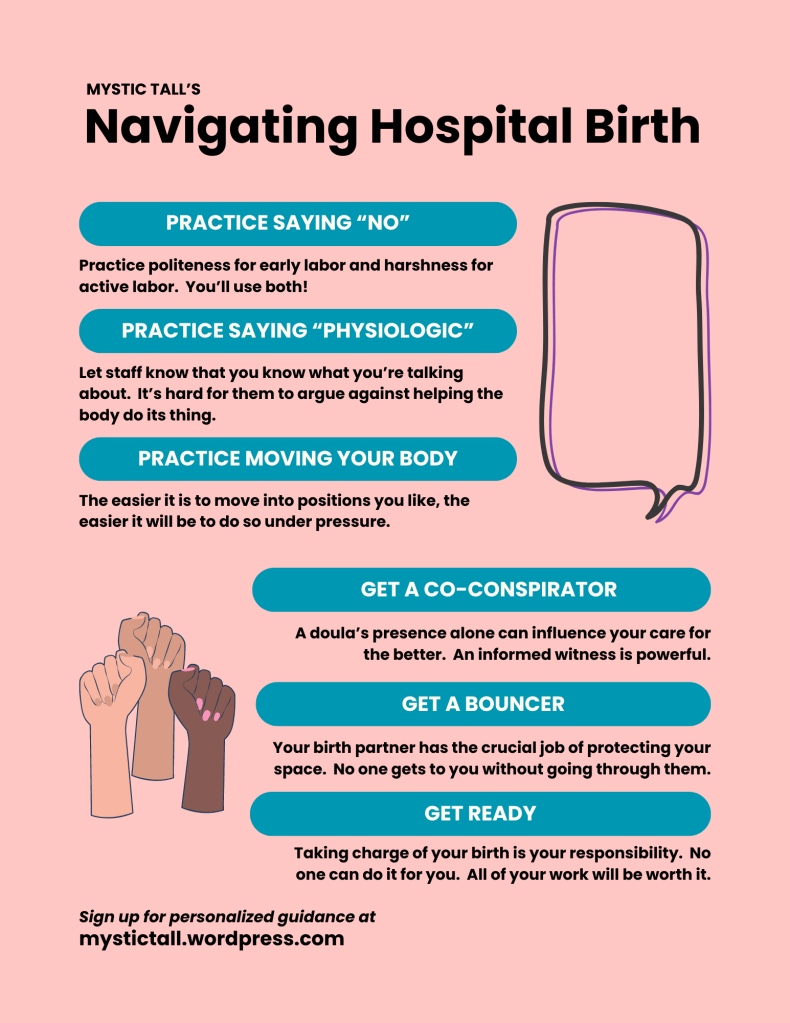
These are my tips for navigating hospital birth:
- Practice saying “NO”
- Practice politeness for early labor and harshness for active labor. You’ll use both!
- Practice saying “PHYSIOLOGIC”
- Let staff know that you know what you’re talking about. It’s hard for them to argue against helping the body do its thing. It also signals that you are prepared to do what it takes!
- Practice moving your body
- The easier it is to move into positions you like, the easier it will be to do so under pressure.
- Get a co-conspirator
- A doula’s presence alone can influence your care for the better. An informed witness is powerful, even if you don’t need hands-on help.
- Get a bouncer
- Your birth partner has the crucial job of protecting your space. No one gets to you without going through them. This will take work up-front to establish, but in the long run it can protect you from coming out of Laborland to make intellectual decisions.
- Get ready
- Taking charge of your birth is your responsibility. No one can do it for you. All of your work will be worth it!
 Birth.DIY